The lighthouse motif
The Lighthouse (Alison Moore Edition)The lighthouse motif gives the novel a form in which guidance and danger remain inseparable. A lighthouse is a visible warning meant to prevent wreckage, yet wrecks still occur; its light can be mistaken for welcome, and its miniature likeness travels with Futh as a perfume case bound up with inheritance, maternal loss, and the smell of violets. Across family memories and the present-day story at the Hellhaus Hotel, the image promises safety without ever guaranteeing it.
Beacon, Warning, and Wreckage
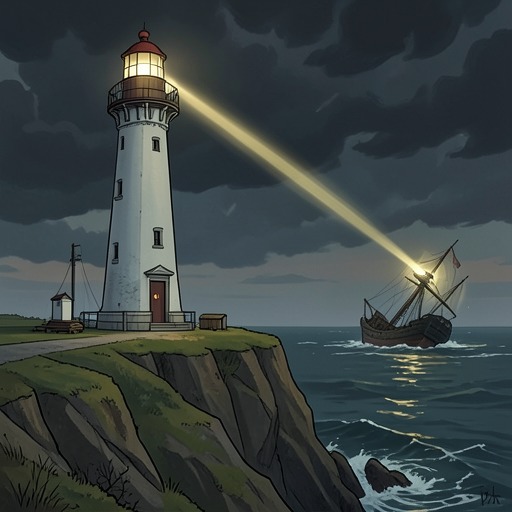
The motif is established before the main story begins with an epigraph describing a tall lighthouse whose kindly beams some mistake for welcome rather than warning. That distinction sets the terms for the object’s recurring meanings: a signal can be clear and still be misread, while the presence of a warning does not ensure that anyone will escape harm. The lighthouse is not a simple emblem of rescue. Its light marks danger as much as it offers direction.
Futh’s father makes that contradiction concrete during a family outing on the cliffs in Cornwall. He lectures about eighteenth-century shipwrecks, the bodies washed ashore and buried namelessly in unconsecrated dunes, and the plundering that followed wrecks. He explains that a lighthouse flashes every three seconds and can be seen from thirty miles away; in fog, a foghorn is used. Futh looks at the lighthouse and wonders how precautions can be so constant while wreckage continues. The question makes the beacon’s failure of absolute protection part of the motif from the start.
A later recollection extends the lecture into lighthouse technology and labor. Futh’s father describes sunlight, lamplight, mirrors, and keepers who tend the building and polish its lenses and windows. Through the language of care, the lighthouse seems to the boy like a calm, safe place whose light could guide someone home. But his father says that lighthouses are automated now, and his disappointment makes the human keeper’s attentive presence seem lost. The contrast between tending and automation adds another limit to the promise of safety: even an enduring signal may no longer have a person behind it.
The Cliffside Memory and the Broken Vial
The lighthouse becomes inseparable from Futh’s mother through the silver perfume case he takes from her handbag during that same hot summer in Cornwall. It is an heirloom from his father’s German grandmother, passed through his grandfather and father, and it contains his mother’s violet perfume. Futh holds the case while his father speaks about shipwrecks, then removes the vial. He wants to smell his mother’s scent, but does not take out the stopper. The small act places the object between possession and restraint: he has taken it, yet does not open it to satisfy his longing.
The family’s picnic turns into a scene of separation. His mother, lying in the sun, tells his father how much he bores her; after a pause, his father packs away the food. Futh sees that the glass vial has broken in his palm. Its perfume runs into the cut, stings the wound, and soaks his boots. The fragrance rises from him as the adults’ marriage reaches its breaking point. Soon his mother says she is going home; Futh notices redness on her cheek, while the broken vial and perfume remain on his injured hand and the grass. On the train afterward, she offers him an orange, which he accepts despite not wanting it. The lighthouse’s warning and the child’s injury thus accompany a departure that he cannot prevent or fully understand.
The spilled perfume gives the motif an afterlife in memory. For a long time, Futh raises his palm to his nose searching for the smell of violets. In another childhood recollection, the scent he associates with his mother is more complex: the leather, secret cigarette smoke, and camphor of her wardrobe, where he used to sit hidden among her skirts. He imagines bottling that atmosphere as an essence of his mother, but the silver lighthouse contains violets instead. The case can preserve a fragrance, but it cannot contain the full presence he misses.
Inheritance, Travel, and the Meaning of Home
The silver lighthouse also carries a family history that is incomplete and disputed. Futh’s grandfather tells his father that the case belonged to his mother and should be returned to Ernst. Futh’s father later gives it to Futh’s mother, who admires the case and the vial, approves the scent, and applies it to her wrists and throat. The car fills with violets. For Futh, the family heirloom consequently becomes associated not only with German ancestry but with his mother’s body and the intimate trace of her perfume.
During a visit to Ernst, Futh’s father recounts how his own father left the family after getting a girl into trouble and fearing a beating from her brothers. The family’s surprise, Ernst explains, was that he took valuables belonging to his mother. Most were returned by post, except a perfume bottle in a silver case. Ernst suggests it may have been given to Futh’s mother; Futh’s father replies that his own father possessed it intact in his eighties before giving it to his wife. The object’s uncertain path makes inheritance less a clean transfer than a history of absence, secrecy, and competing explanations.
At Ernst’s house, photographs briefly unsettle Futh’s sense of his place in that history. He thinks an old portrait is a photograph of himself and feels that something about it is wrong, then realizes the boy pictured is his young grandfather; a similar portrait shows Ernst as a child. When Ernst hands the visitors their coats, he tells Futh that he is just like his brother. On the walk back to the car, the lighthouse bangs against Futh’s chest inside the secret pocket of his coat, feeling enormous there. A tiny keepsake has become physically insistent, carrying the weight of a family resemblance and a past that Futh has only partly understood.
Ester’s Lighthouse and the Stolen Scent
The motif acquires a parallel form through Ester’s wooden lighthouse perfume case. Bernard gives it to her the morning after their wedding, but it is not the silver version she had asked for: Dralle’s Illusion was advertised as an exceptionally costly perfume, and its lighthouse cases came in silver and in a smaller, cheaper wooden design. Ester is disappointed to receive the wooden one. The contrast between the two cases introduces a second history of desire and disappointment into the motif, rather than making the lighthouse a possession with one fixed meaning.
Ester knows perfume intimately. As a child she collected samples brought home by her mother, who travelled for a toiletries company, and wore different scents on different pulse points. She even tried to create a perfume of her own, replacing her mother’s signature scent in its bottle with her sticky homemade mixture. In the present, after years of not wearing Bernard’s gift, Ester opens the wooden lighthouse and smells the violets. The silver case she has found in Futh’s suitcase is empty, but she later places the perfume vial from her wooden lighthouse inside it and returns the now-empty wooden case to a drawer. The exchange joins the two versions of the object while leaving their different histories intact: the silver case is Futh’s inherited keepsake, and the violet scent has become something Ester can transfer into it.
At the Hellhaus Hotel, the literal setting echoes the motif. After driving the wrong way around the M25 and arriving late, Futh sees the whitewashed hotel shining in the moonlight. He understands its name as meaning bright house or light house, and the building appears as a beacon after his exhausting journey. The welcome is uncertain, however: Ester is annoyed by his lateness and does not want to engage with him, even as she feeds him. While bringing him cold meats, she notices the silver lighthouse in his open suitcase, among his clothes and books. The hotel’s bright appearance therefore does not resolve the gap between beacon and welcome established by the epigraph.
Recurrence and Uncertain Protection
Futh carries the silver lighthouse whenever he travels, holding it in his pocket as if it were a Saint Christopher. This habit turns the heirloom into a personal safeguard, but the story repeatedly qualifies that hope. He has carried it on the earlier trip to Germany, including the visit to Ernst, without returning it as his grandfather had requested. The case accompanies him across journeys, but it does not settle his family’s history or answer the loss that first made its scent so powerful.
At the hotel, Futh discovers that the lighthouse is missing only after he has bathed. He searches his suitcase, then later enters Ester’s private apartment looking for it. In a dressing-table drawer he finds make-up, jewellery, and what he first mistakes for a moth brooch before realizing it is a real moth; in another he finds the pink satin underwear he had encountered before. The final drawer holds Ester’s many perfume bottles, her wooden lighthouse, and what appears to be his silver one. As he takes it, the sound of Ester entering makes him retreat into the bathroom. He is vaguely aware that the lighthouse feels unusually heavy. The motif’s significance rests in this unresolved transfer: the object still offers the shape of protection, but its ownership, contents, and ability to guard anyone remain uncertain. Like the distant beacon above the wrecks, it can signal meaning without preventing harm or guaranteeing a safe return.